
From free text to validated NEO PI-R facets — no black box
Type “personality test” into any app store and you’ll find hundreds of results. Swipe through a few questions, get a cute animal or a four-letter code, share it on your story. It’s entertainment, and there’s nothing wrong with that — but it’s not psychology.
The problem is that most of these tools, especially the new wave of “AI personality” apps, don’t actually connect to anything scientific. They generate a plausible-sounding read of your text, wrap it in a nice UI, and call it a personality profile. There’s no underlying framework, no validated item bank, no way to check the output against decades of research. It’s a black box trained on vibes.
We built Sentino because we think personality assessment deserves better than that — especially now that so much of it is happening automatically, at scale, and increasingly behind the scenes in hiring tools, coaching platforms, and dating apps. If a system is going to make claims about someone’s personality, it should be traceable back to real psychometric science. So we want to walk through exactly how our pipeline works, warts and all.
The problem with “vibes-based” AI
Large language models are very good at producing text that sounds like a personality assessment. Ask one to analyze a paragraph and it will confidently hand you back Big Five-flavored language — “high openness,” “moderate conscientiousness” — without ever having compared that text to an actual normed population, an actual item bank, or an actual validated construct. There’s no way to know if the numbers mean anything, because there’s no reference point behind them.
That’s the gap we set out to close: keep the language-understanding power of modern NLP, but ground every score in established psychometrics rather than a model’s unverified intuition.
The actual pipeline: text → statements → validated constructs
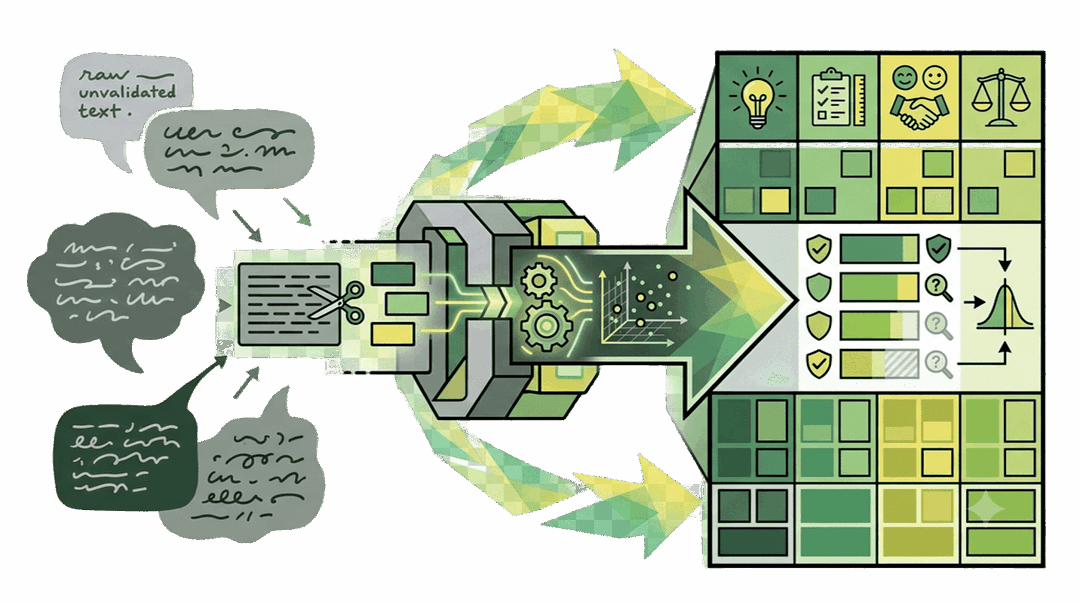
Here’s the process, in plain terms:
1. Breaking the text into individual statements. Whatever you feed the system — a self-description, an interview transcript, a written questionnaire response — we chunk into smaller units: individual sentences or question-answer pairs. We treat each of these as an “item,” the same unit psychometricians have used for decades when they design personality inventories.
2. Projecting each statement into a shared psychological space. This is the part that differs most from keyword- or sentiment-based tools. Rather than scanning for specific words, we use a transformer-based language model to place each statement into a multidimensional space that we built from a large correlation matrix of real psychometric items — thousands of statements drawn from established inventories, where each item’s position reflects how it actually correlates with every other item and with the framework dimensions themselves (Big Five traits, NEO PI-R facets, RIASEC codes). Two statements that mean similar things — “I like being around people” and “I get energized at parties” — end up close together in that space, even though they don’t share many of the same words.
3. Aligning statements to the frameworks. Once a statement has a position in that space, we can measure how closely it relates to each dimension of each inventory: not just “Extraversion” as a whole, but the specific facets underneath it. A single sentence can inform several facets at once, the same way a real answer on a paper questionnaire does.
4. Calculating scores, quantiles, and confidence. Raw closeness-to-a-dimension isn’t very meaningful on its own, so we convert it into a score, place that score against a known population distribution to get a quantile, and — importantly — attach a confidence level. If your text gives us a lot to work with on a given trait, the confidence comes back high. If it barely touches on a trait, the confidence comes back low, and we say so rather than quietly padding the score.
That last point matters more than it might seem. A tool that hands back five confident numbers no matter how thin the input is arguably works the same as a tool that’s making it up.
What a facet-level profile actually looks like
To make this concrete: imagine someone writes a short self-description mentioning that they like planning things out, get along well with most people, and occasionally worry about deadlines. A facet-level NEO PI-R readout from that kind of input might look something like this:
| Domain | Facet | Score | Confidence |
|---|---|---|---|
| Conscientiousness | Order | 0.81 | High |
| Conscientiousness | Self-Discipline | 0.68 | Medium |
| Agreeableness | Trust | 0.74 | Medium |
| Agreeableness | Altruism | 0.70 | Medium |
| Neuroticism | Anxiety | 0.58 | Medium |
| Openness | Ideas | 0.52 | Low |
Notice that not every facet comes back with the same confidence — Openness barely got touched on in this hypothetical example, so its confidence is lower, and a good system should say that plainly instead of hiding it.
This is a stylized example, not a real user’s data, but it reflects the actual shape of what the pipeline produces: domain-level traits broken down into their component facets, each with a score, a population-relative quantile, and an honest confidence rating.
Why these specific frameworks
We didn’t invent our own taxonomy of personality — on purpose.
Big Five (OCEAN) is, by a wide margin, the most extensively validated personality model in academic psychology. Decades of cross-cultural replication link it to real-world outcomes, from career trajectories to relationship satisfaction. If a personality tool doesn’t map to something Big-Five-compatible, it’s operating outside the mainstream of the field.
NEO PI-R is the more granular, clinical-grade instrument built on top of the same five-factor structure — 30 facets across the five domains, developed by Costa and McCrae and widely used in clinical and research settings where precision matters more than a quick read.
RIASEC (Holland Codes) comes from a different tradition entirely — vocational psychology — and is the backbone of career counseling programs worldwide. It maps interests and work-style preferences to occupational fit rather than general disposition, which is why it’s a different, complementary lens rather than a redundant one.
We layer custom inventories on top of these for narrower or more specific use cases, but the foundation is always tied back to frameworks that have been tested, published, and scrutinized by the field — not something we made up to sound scientific.
Where this approach actually falls short
Being upfront about limitations is, in our view, part of what separates a credible tool from a black box.
- Semantic analysis can only work with what’s in the text. If someone’s writing doesn’t touch on a trait at all, we won’t inflate the score to look complete — that’s exactly what the confidence rating is for.
- Complex language is still hard. Double negatives, irony, and metaphor remain genuinely difficult for any NLP system, ours included, and can occasionally produce a misread on a specific statement.
- Text-derived inference is not a clinical assessment. A profile built from a paragraph of writing is a useful, fast approximation — not a substitute for a full clinical interview or a completed 240-item NEO PI-R administered by a trained professional. We built this as a tool for self-understanding, product integration, and screening-level insight, not diagnosis.
- Coreference and context carry over between sentences, which means the meaning of one statement can depend on the one before it — a known hard problem in NLP generally, and one we’re continuing to work on.
None of this makes the output meaningless. It means the output is honest about its own precision, which is the whole point.
Try it yourself
You can build your own profile for free — write a self-description, answer a short questionnaire, or paste in a piece of writing, and see the facet-level breakdown for yourself.
Create Your Profile — Free!
If you’re building a product and want to integrate validated personality scoring directly — for hiring, coaching, education, or matching use cases — the full technical documentation, including the underlying methodology paper, is available here:
API DOCS →
FULL METHODOLOGY PAPER →
We’d genuinely like to hear from people who know this field well. If you have thoughts on where the approach holds up and where it doesn’t, get in touch — that kind of scrutiny is exactly what makes a tool like this better.